What an Agentic Dispatcher Actually Does
A routing tool answers the question you ask it. An agentic dispatcher owns the question. Here's what that difference means for anyone running a bin network, a donation pickup program, or a collection fleet.
Plutou Team
7 min read
It's 3:40 on a Friday afternoon. Everyone else is thinking about the weekend. The dispatcher is thinking about Monday.
Next week's routes don't exist yet. So they open the location spreadsheet, the routing tab, last week's route sheets, and a group text full of photos, and they start building. Which sites got skipped. Which host called. Which driver is out Wednesday. Two hours later there's a plan. By Monday at 7 a.m. it's already wrong.
One operator we spoke with put it better than we could: "Routing is being dictated by what I can best describe as good feeling."
That isn't a knock on the dispatcher. Good feeling is years of experience. The problem is that none of the software around them does the thinking. It stores what they decide. It draws the lines they ask for. The deciding is still all on them.
An agentic dispatcher changes who does that work.
The short definition
An agentic dispatcher is software that plans your operation's week, keeps that plan current as things change, and gets better with every pickup, while your team stays in control.
The important word is agentic. It means the software acts. It doesn't wait for someone to hand it a stop list and press "optimize." It works out what needs to happen, proposes the plan, and updates it when the day changes. A person reviews it, changes anything they want, and signs off.
Routing tool vs. dispatch software vs. agentic dispatcher
Most collection operators have used at least one of the first two. They're useful. They just stop short of the hard part.
| Routing tool | Dispatch software | Agentic dispatcher | |
|---|---|---|---|
| Who builds the week? | You pick the stops, it orders them | You build it, it stores it | It builds it, you review |
| Driver calls out Wednesday | Start over | Move stops by hand | Everything after that adjusts |
| Which sites need service? | Whatever's on your list | Whatever's on the schedule | What actually needs service |
| Field data | Not its job | Typed in after the fact | Comes back from every stop |
| Next month | Same as this month | Same as this month | Better than this month |
A routing tool answers the question you ask it: what's the fastest order for these 40 stops? That's a real question, but in collection it isn't the hardest one. The hardest question is which 40 stops.
Dispatch software keeps a record of the answer. It's where the plan lives once a person has made it. It rarely makes the plan itself.
An agentic dispatcher takes on the question. Which sites need a truck this week, which can wait, who drives what, and in what order. Then, when the week changes, it answers it again.
What an agentic dispatcher actually does
1. It builds the week
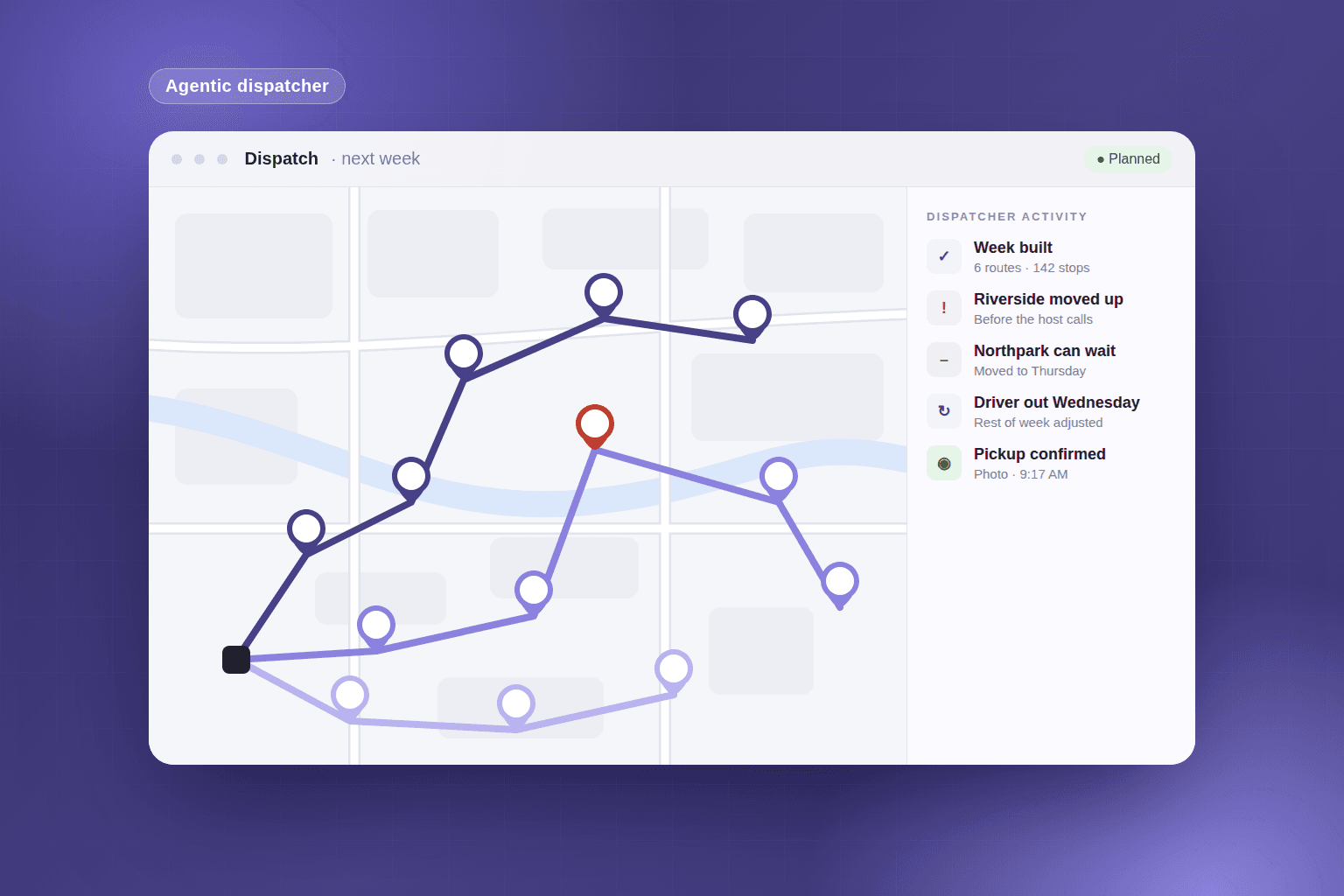
The first draft of next week exists before anyone opens a laptop on Friday. It works from your locations, your drivers and trucks, your service commitments, and what's been happening in the field. The dispatcher's job shifts from building the plan to reviewing it, and Friday afternoon goes back to being Friday afternoon.
2. It keeps the week current
This is the part static schedules can't do. A driver calls out. An overflow gets called in. A store changes its hours. A customer moves a pickup. With an agentic dispatcher you make one change and the rest of the week adjusts. Days that are done stay locked. Routes you've hand-tuned stay yours. Nobody rebuilds anything from scratch.
3. It sends trucks where they're needed
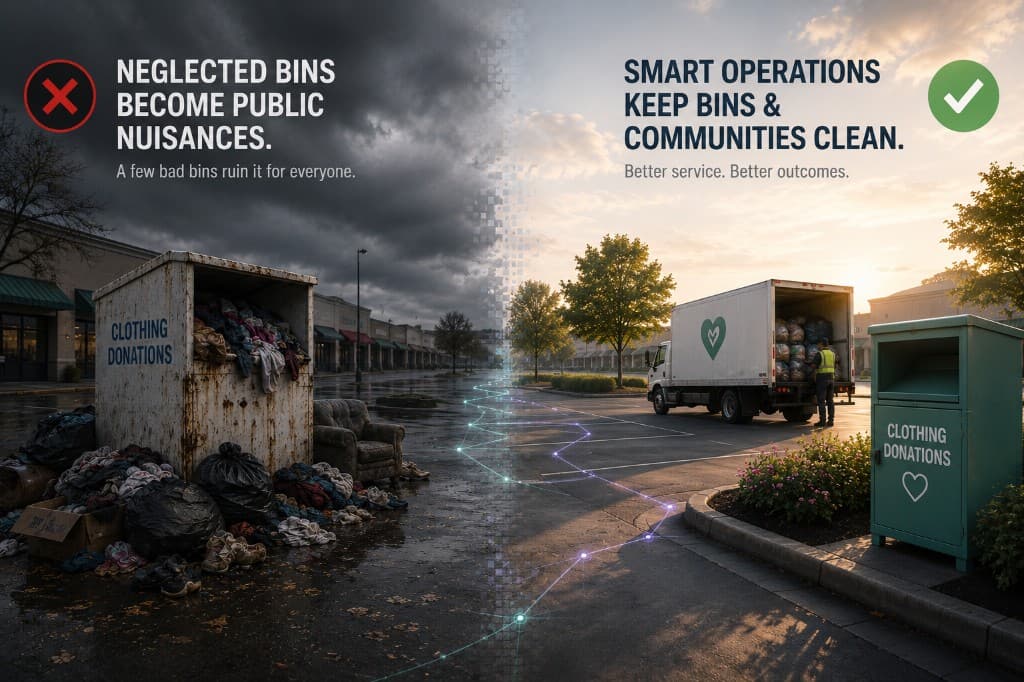
In collection, a calendar is a guess. Service a bin every Tuesday and some Tuesdays it's overflowing, and some Tuesdays you drove 45 minutes for two bags. An agentic dispatcher puts the sites most likely to cost you a placement at the front of the line and lets the ones that can wait, wait. As one textile operator told us, "It takes one week and the site's ruined." The whole point is to never have that week.
4. It closes the loop
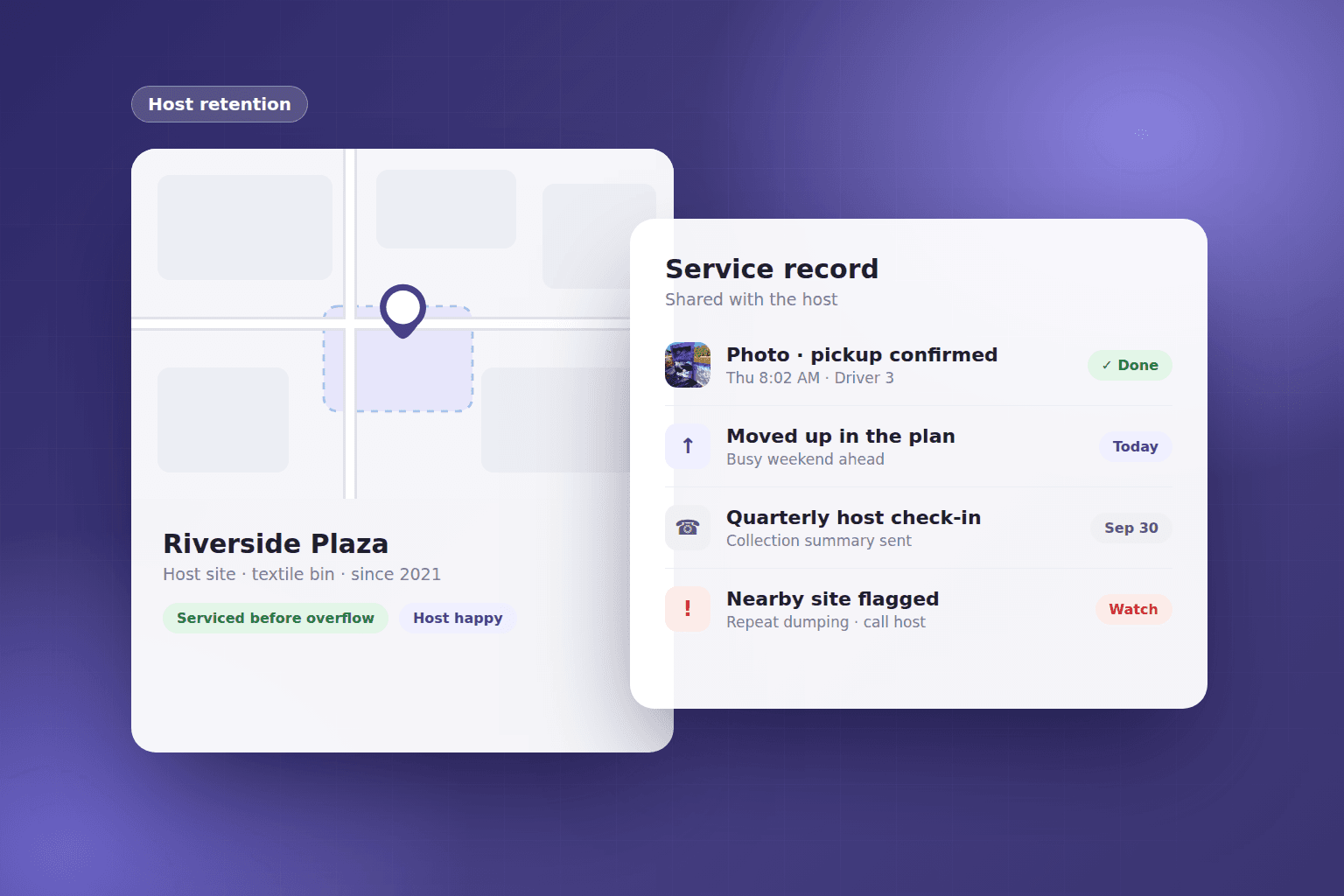
Every stop comes back as information: a photo, a timestamp, a skip reason, a weight. Drivers capture it in the driver app as part of finishing the stop, not as paperwork afterward. That's what lets the plan improve. It's also what lets you show a host, a council, or a tender exactly what happened at a site and when.
What it isn't
It isn't autopilot. Collection happens in the physical world. Gates are locked, trucks break down, a host wants the bin moved ten feet to the left. There will always be judgment calls, and those stay with your team. A good agentic dispatcher makes its plan easy to read and easy to override.
It isn't a replacement for your dispatcher. It's the opposite. Most operations have one person holding the whole thing together, and they're usually the most overloaded person in the building. Another operator described their lead dispatcher this way: "He's not going to be around forever. His experience will go with that. And I need something that will essentially learn that experience without it disappearing." An agentic dispatcher keeps that knowledge in a system that doesn't take days off, and gives the person their evenings back.
It isn't a chatbot. Adding a chat window to a routing tool doesn't make it agentic. If you still build the plan and the software still waits to be asked, nothing has changed. (We wrote more about this in what an AI-native operations platform actually looks like.)
Why collection needs its own
"Agentic dispatch" is starting to show up across delivery, field service, and fleet software. Most of those products are built on one assumption: the list of jobs is already known. A package has an address. A service call has a ticket. The software's job is to put them in order.
Collection doesn't work that way. The list of jobs is the hard part. A bin network, a donation pickup program, or a roll-off operation has hundreds or thousands of sites that each need service on their own schedule, and that schedule changes with the season, the neighborhood, and the week. On top of that, the cost of getting it wrong is lopsided. An extra trip to a half-empty bin costs fuel and an hour. Missing an overflowing one can cost you the site.
A dispatcher built for collection has to understand that tradeoff. Generic routing engines weren't built to, and bolting AI onto them doesn't change what they were built for. It's why we built Plutou for collection operators specifically.
Six questions to ask anyone selling one
If a vendor tells you their product is an agentic dispatcher, these questions will tell you quickly whether it is:
- Does it build next week's plan, or does it optimize a list I give it?
- A driver calls out Wednesday at 6 a.m. What do I actually have to do?
- Can I lock what's already done and let it re-plan everything else?
- Does field data come back from the stop, or does someone type it in later?
- Will next month's plan look different because of what happened this month?
- Can my dispatcher see and change anything it decides?
If the answers are "you give it the list," "rebuild the day," and "someone enters it at the end of the shift," you're looking at a routing tool with a new label.
The bottom line
Collection operators have spent years as the glue between tools that don't talk to each other. The spreadsheet holds the locations, the routing tab holds the order, the group text holds the truth, and one person holds all of it in their head.
An agentic dispatcher holds it instead. It builds the week, keeps up when the week changes, and gets a little sharper every time a driver finishes a stop. Your team does what only people can do.