How to Keep Your Donation Bin Locations: A Host Retention Playbook
Most donation bins sit on land the operator doesn't own. Lose the host and you lose the site, the donors who used it, and everything that would have come out of it. Here's how the best operators keep their placements.
Plutou Team
8 min read
Every bin operator knows the call.
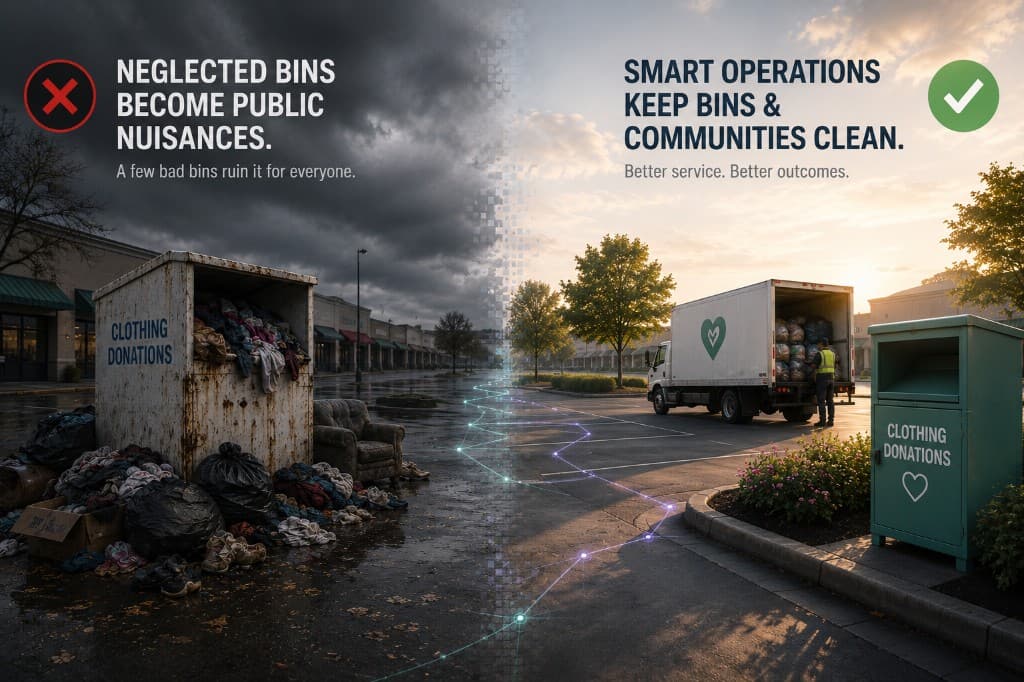
It's the property manager at the gas station on Route 9. There are bags on the ground again. Someone left a mattress. A customer complained. They're polite about it the first time. They're not polite the second time. The third time, they want the bin gone by Friday.
A textile collection operator summed it up in one line: "It takes one week and the site's ruined."
That's the job, really. Not collecting clothes. Keeping the places you collect them from.
Your placements are your business
Most donation bins sit on land the operator doesn't own: a gas station, a church lot, a grocery store, a strip mall. The host agreed to a clean box that does some good for the neighborhood. They didn't agree to a trash problem.
When a host pulls a bin, you lose more than a stop on a route. You lose:
- The donors. People build habits around where they drop off. Move the bin a mile away and many of them won't follow.
- The time you spent winning the site. Finding a new host, getting permission, sometimes getting a permit.
- Your reputation on the block. Hosts talk to each other, and city councils listen to hosts. We've written about why cities ban donation bins, and it almost always starts with a few neglected sites.
Losing a site is expensive, and winning one back is harder than keeping it. That's why retention deserves a plan, not just good intentions.
Why hosts actually pull bins
Almost never because of the bin itself. When operators tell us about the sites they lost, the same reasons come up again and again:
- Overflow. Bags stacked around a full bin. This is the big one. One operator told us plainly, "The overflows is what kills us."
- Dumping. Once there's a pile, people add to it. Furniture, electronics, trash. The host now has a dumping problem with your logo on it.
- Complaints from their customers or the city. "They're an eyesore nuisance… the mayor said no more."
- Nobody picks up the phone. The host doesn't know who to call, or calls and nothing happens for a week.
- No visible upside. Most hosts aren't paid. As one operator put it, "90% of our sites aren't paid… the tolerance of garbage outside is minute." If a bin brings them nothing but headaches, the math is easy.
Notice the pattern. Four of the five are service problems. The fifth is a communication problem. All five are fixable.
The playbook
1. Service to need, not to the calendar
A fixed schedule is the most common cause of overflow. Some bins fill in three days, some take three weeks, and the same bin fills at different speeds in different seasons. Spring cleaning, the end of the month when people move, college move-out weeks, and the stretch right after the holidays all bring surges.
If every bin gets a truck every Tuesday, you're guaranteed to be late at your busiest sites and early at your quietest ones. The operators who keep their placements send trucks where they're needed. The sites most likely to overflow come first, and the ones that can wait, wait.
2. Treat the first overflow like an emergency
Overflow grows fast. A few bags on the ground on Monday are a pile by Wednesday, and the pile invites dumping. The first overflow at a site should move that site to the front of the line, today if you can, not next week when it's scheduled.
Better still: get there before the host sees it. "Before the host calls" is the standard to aim for.
3. Make every driver your eyes
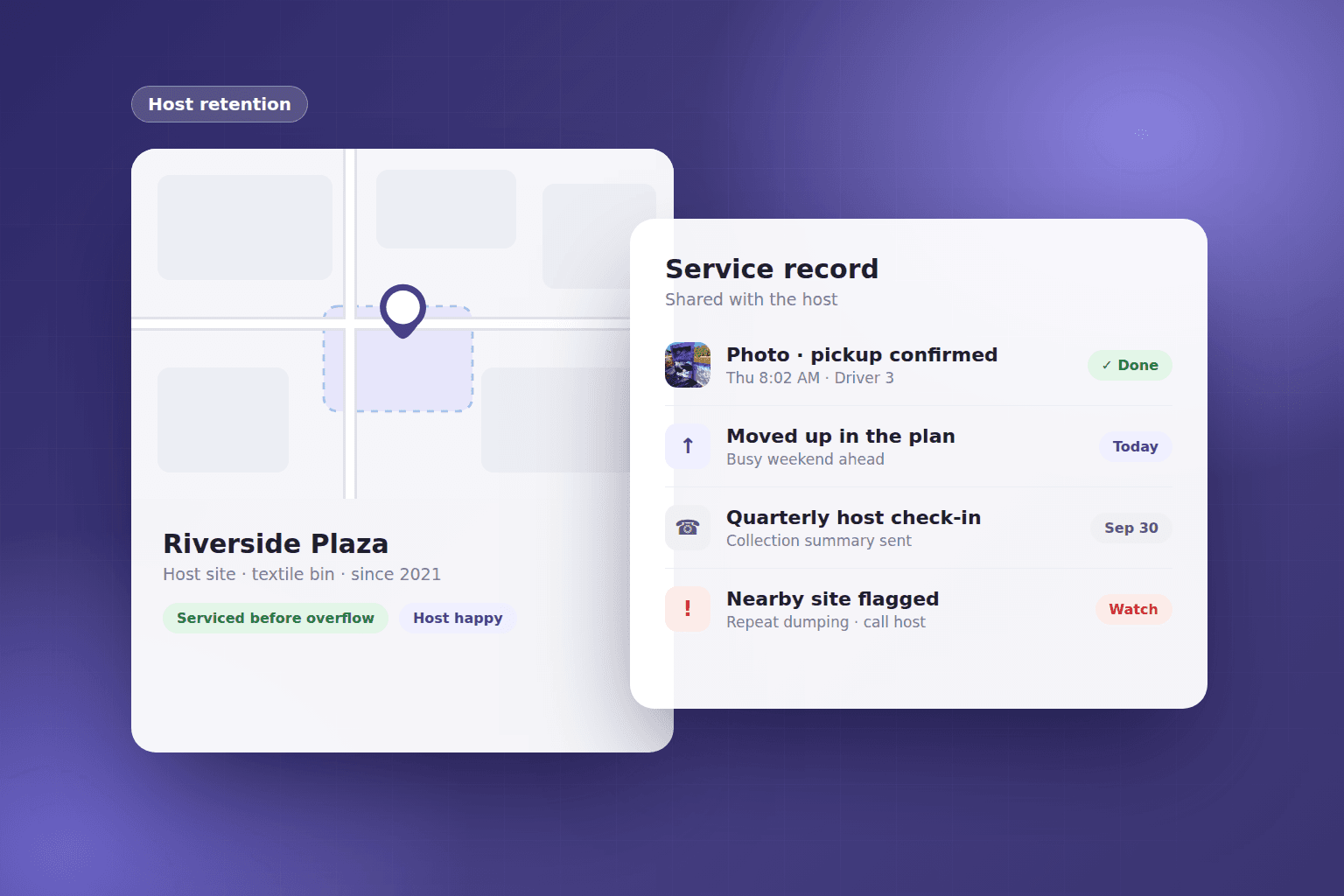
You can't be at every site. Your drivers are. A photo at every stop gives you a record of what the site looked like, lets you catch problems early, and settles "the bin was a mess all week" arguments with facts.
When a driver can't service a bin, the reason matters too. Blocked by a car, locked gate, site closed. One operator described driving 45 minutes to a bin that was blocked by a parked vehicle. Another asked for the minimum: "If they can't get to the bin… at least take a picture and see how much crap's in there." Skip reasons turn a wasted trip into information you can act on.
4. Clean the footprint, not just the box
Hosts don't judge the inside of the bin. They judge the ten feet around it. Pick up loose bags, clear what's been dumped, and leave the pad cleaner than you found it. If the same site keeps attracting dumping, document it with photos and tell the host before they tell you.
5. Give the host one number and a record
Every bin should have a clear label with who runs it, whether it's a charity or a for-profit operation (many cities require this), and a phone number that gets answered. Check your local ordinance. Labeling, permits, and service-frequency rules are becoming more common, not less.
Then go further and give hosts proof. Councils in Ireland have started asking operators for exactly this. In the words of one operator: "One of the things requested by the councils was for them to be able to log into a system and see the befores and afters and a service record." When a host or a city can see that you showed up, and what the site looked like when you left, the conversation changes.
6. Talk to hosts before they have a reason to call
A short check-in every quarter goes a long way. Thank them. Tell them how much their site collected and kept out of the landfill. Ask if anything's bothering them. Most hosts will tell you about a problem early if they think someone is listening, and they'll pull the bin without warning if they think no one is.
7. Know which sites are at risk, and act first
Keep a simple watch list: sites with repeat overflows, repeat complaints, or repeat dumping. Those are the placements you're about to lose. Increase service, fix the footprint, and call the host. Sometimes the right answer is moving the bin to a better spot on the same property. Sometimes it's pulling a chronic problem bin yourself before it damages your relationship with a good host.
One operator told us about a site where the owner wanted the bin gone entirely: "I had to talk to the guy and save the bin." The operators who save bins are the ones who see the problem coming.
When a host says they want the bin gone
It happens even to the best operators. When it does:
- Listen first. Let them tell you exactly what went wrong. Don't argue with the photo on their phone.
- Own it. "You're right, that shouldn't have happened" goes further than any explanation.
- Show your record. If you have photos and service history, walk them through what normally happens at the site and what went differently.
- Offer something specific. More frequent service for the next month, a cleanup today, a new sign, a better position on the lot.
- Follow up. Call again in two weeks. Most saves are won in the follow-up, not the first conversation.
A simple retention checklist
| How often | What to do |
|---|---|
| Every stop | Photo of the site, clean the footprint, log a reason if you couldn't service it |
| Every day | Move any overflowing or complaint sites to the front of today's work |
| Every week | Review sites with repeat overflows, dumping, or skips |
| Every month | Adjust service for sites that fill faster or slower than you planned |
| Every quarter | Check in with hosts and share what their site collected |
| Every year | Review permits, labels, and local ordinances for every site |
Where software fits
None of this is complicated. It's hard because of volume. Doing it for 40 bins with a spreadsheet and a group text is possible. Doing it for 400, or 2,000, is not. The hard part is knowing, every morning, which sites need you today.
That's what we built Plutou to do. The sites most likely to overflow stay in front of dispatch, so they get serviced before a host ever picks up the phone. The ones that can wait, wait, so trucks stop burning hours on empty bins. Drivers confirm every stop with photos in the driver app, and every location keeps a service record you can show a host, a council, or a tender.
Your placements are the business. Keep them.