Why Cities Ban Donation Bins (and Why That Backfires)
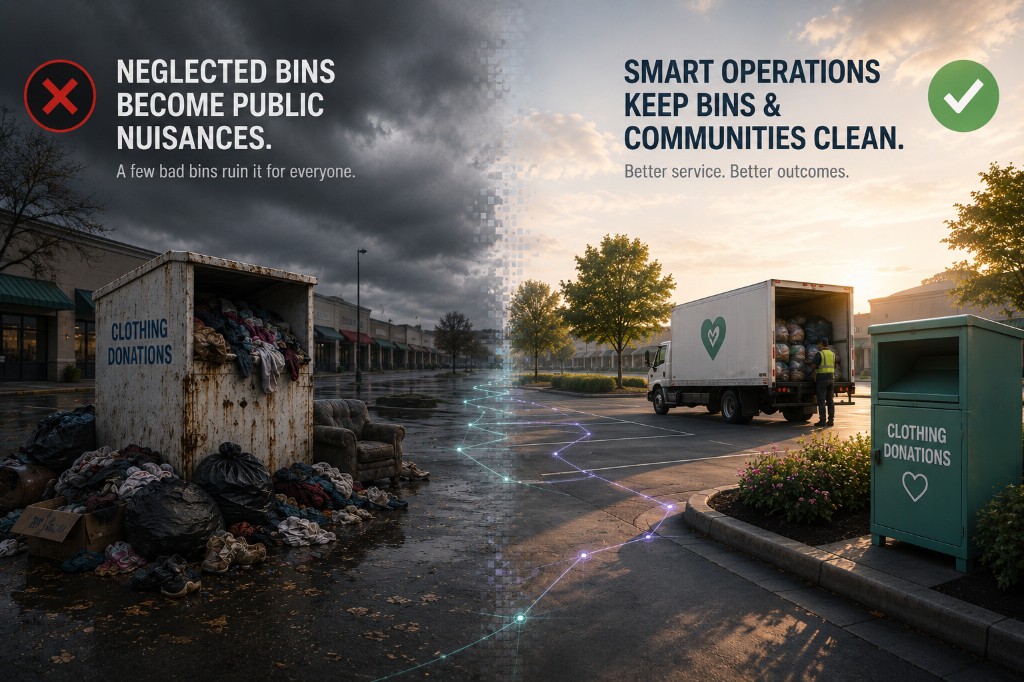
Cities don't ban donation bins because bins are bad. They ban them because a few get neglected and the whole industry takes the blame. But banning them fixes nothing. It just sends the clothes to the trash.
Most people see a donation bin ban and think: good. We don't need those disgusting things in our city. A city council got annoyed, a few bad apples gave the rest of the industry a bad name, and a few boxes disappeared from a parking lot. End of story.
But it isn't the end of the story. It's a service story.
Cities don't ban these bins because they're bad. They ban them because of the lack of care around a few of them. The clothes left on the ground. The furniture nobody came back for. The bin is the thing with a logo on it, so the bin takes the blame. One bad apple, and the whole bunch gets judged by it.
The property owner's side of it
Most donation bins sit on land the operator doesn't own. A gas station, a church, a strip mall. The property owner agreed to a clean box. Maybe it brings a little foot traffic, maybe a little money, but mostly it feels like a good deed: a way for the neighborhood to reduce, reuse, and keep clothes out of the landfill. What they did not agree to is a trash container.
So the minute a couple of bins start looking dirty, the property owner is done. And when they pull a bin, the operator doesn't just lose a pickup. They lose a piece of their network, a spot people in that neighborhood actually used. Every one of those is one more place where clothing that could have been worn again ends up in a trash bag instead.
It's happening more, not less
California cities have restricted bins after complaints about public nuisance, scavenging, and illegal dumping. Crest Hill, Illinois banned them outright, describing the boxes as overflowing depositories for discarded items; today the city has none. Santa Fe, Texas moved in 2026 to prohibit outdoor donation bins after years of complaints.
Read the ordinances and the same words repeat. Eyesore. Nuisance. Dumping. The complaint is almost never the bin. It's the mess around a few of them.
And the logic doesn't quite hold up. These cities aren't banning dumpsters or trash cans, which overflow and attract dumping just as often. They're singling out the one container whose entire job is to keep material out of the landfill. Operators have challenged some of these ordinances, and courts have struck several down as limits on protected charitable speech. Santa Fe called its ordinance a way to strike a balance. It doesn't. It makes it harder to do the exact thing the city says it wants. Illegal dumping happens everywhere, next to every kind of bin. You don't fix it by removing the one that does some good.
Why the ban backfires
Here's what gets missed in the council meeting. Ban the bins and the clothes don't go somewhere better. They go to the landfill.
Around 95% of used textiles can be reused or recycled, and only about 15% actually are. The rest gets thrown away. In California alone, roughly 1.2 million tons of textiles were landfilled in a single year, nearly all of it recoverable. That is 2.4 billion pounds. Unsorted donations straight out of the bins get baled and sold to graders and exporters as credential clothing, usually thirty to sixty cents a pound. Even at the bottom of that range, that single year of California waste is worth around $720 million as raw material. At a typical rate it is closer to a billion. And the city paid to put it there.
That is the part worth sitting with. A ban doesn't just remove an eyesore. It buries a stream. Every ton of textiles that goes into the trash instead of a bin is a ton the city hauls and dumps on its own dime, when it could have been collected, sorted, and sold instead. The bin that looked like a liability in a parking lot was a diversion stream the city never had to build or fund. Run well, that same stream keeps material out of the ground and the area around it clean, at no cost to the city. Banning it doesn't make the textiles disappear. It moves them onto the city's tab.
Collection bins are one of the few things moving that 15% number. In the US, that work is defended by SMART; in the UK, where the same bins are called clothing banks or textile banks, by the Textile Recycling Association. Both support real regulation and codes of conduct, and both go after the bad-actor collectors directly, because the alternative is cities legislating the whole category out of existence.
That fight gets more important every year, not less. Fast fashion is pushing more textile volume into the system than the recovery infrastructure can handle. The US alone sends more than 11 million tons of textiles to landfill a year, and bins on the ground are a big part of how any of it gets caught at all. Most of what people drop in them gets reused far longer than they would guess, through a global chain of sorting, grading, and resale.
The usual answer to a ban is just take it to a Goodwill or a Savers. But there isn't one on every corner, and people are human. Convenience is most of what decides whether a worn-out shirt gets donated or thrown out. Take away the bin on the route someone already drives, and a lot of that material simply stops getting recovered.
The part the industry has to own
It would be easy to stop there and blame the cities, but they're reacting to something real. A lot of bins out there are run by operators who drop a box and barely come back. Some are for-profit outfits dressed up to look like charities. A city looking at a parking lot can't tell the well-run nonprofit bin from the abandoned one. They all look the same, and they all get judged by the worst one on the block.
And the uncomfortable truth is that the mess usually isn't dumping. It's service. Running a textile-collection network is harder than it looks, and the teams doing it often don't have tools built for how collection actually works. So they do their best with what they have, and a few sites fall behind. The pile forms, the complaints start, and a whole operation gets judged by the handful of bins that slipped. Which is, ironically, the same move the city then makes: reach for the bluntest available tool to make a mess go away.
The bins are a real public good. Keeping them in communities is partly a job for regulators, but it's just as much a job for the people who run them: to service them well, and to present them like they matter. That's on us as much as anyone.
What survives
Bin bans aren't going away. Fast fashion isn't slowing down, more cities are writing textile rules, and producer-responsibility laws, from California to the EU, are redrawing how used clothing gets collected. The cities banning bins today are quietly pulling out the exact drop-off points the next decade of textile policy is going to lean on. The bins that make it through won't be the ones with the best intentions. They'll be the ones nobody has a reason to complain about.
The bin was never the problem. A few neglected ones were. That's a fixable problem. A city's worth of clothing in a landfill is not.