Donation Collection Software: Why Most Operations Are Held Together With Duct Tape
Most donation collection operators run on four disconnected tools. Here's what a purpose-built collection platform looks like, and what the duct-tape stack actually costs you.
Plutou Team
7 min read
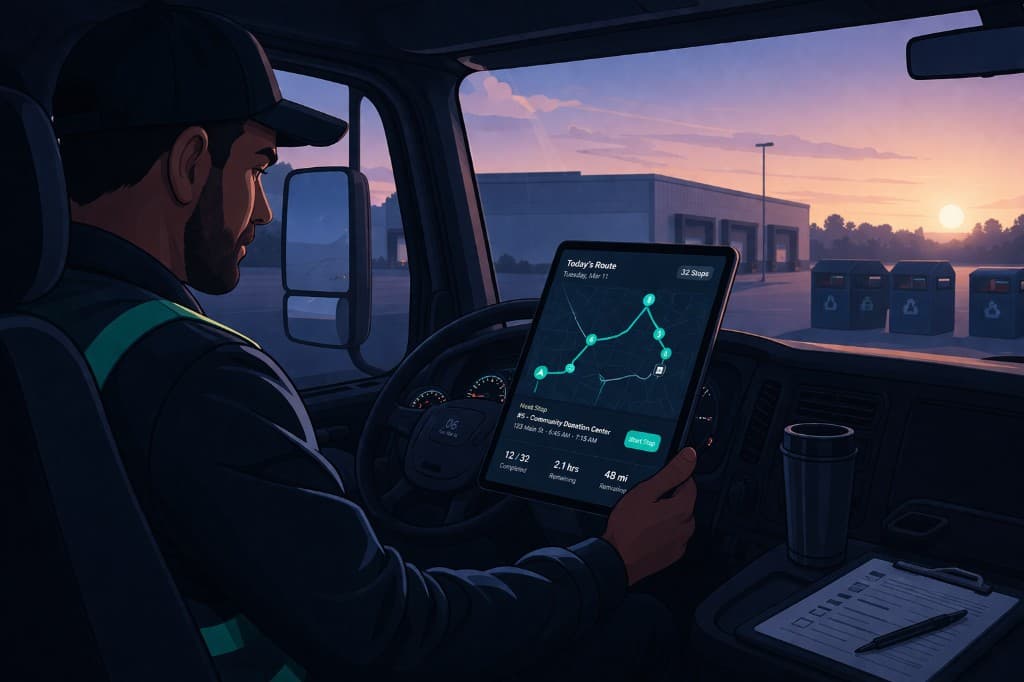
Ask a donation collection operator what software they run, and the answer usually sounds the same: a routing app, a GPS tracker, a spreadsheet for the location list, and a paper sheet for the driver.
That isn't a stack. It's a workaround. And it's the norm.
Most donation and textile operators run on four kinds of tools that don't talk to each other. Each solves a narrow piece of the problem. Someone has to glue them together by hand every morning. By the time you add up the subscriptions, the dispatcher hours, and the rework, the duct-tape stack often costs more than the dedicated software would.
The good news: this is a solved problem. The bad news: most of the tools operators find when they go shopping weren't built for donation collection.
What operators are using today
Walk into a typical operation and you'll find four categories of software running side by side, none of them connected to the others.
1. Routing and field service. Usually WorkWave, Routific, OptimoRoute, or Route4Me. All capable route optimizers, but built for last-mile delivery rather than a fixed network of bins on a recurring schedule. Vonigo also shows up. It's strong for residential pickups, but bins aren't jobs.
2. Fleet telematics. Samsara, Motive, Geotab for tracking the trucks. Good at what they do. They just live in a separate window from whatever is planning the routes.
3. Fill-level sensors. Sensoneo, NordSense, Reen, and Enevo build hardware purpose-built for donation and textile bins. The data is genuinely useful, but only if the rest of your system can act on it. Most generic routing tools can't.
4. Spreadsheets and back office. Excel and Google Sheets for the master location list and weekly schedule. QuickBase for cobbled-together internal apps, plus thrift retail platforms like Thriftly, Thriftworks, and ThriftCart for what happens inside the store. The route gets printed, handed to the driver, and updated by phone if anything changes.
None of these tools are bad. They were just built for someone else.
The actual problem
Bin and container collection has a few constraints that don't really show up anywhere else:
- Hundreds or thousands of fixed locations that need recurring service, not one-off jobs.
- Frequency-driven scheduling. Some bins are weekly, some biweekly, some only when they're flagged. The rules change as the network grows.
- Volatile routes. A callout, an emergency pickup, or a new partner location can rewrite the day.
- No customer at the address. The work is self-directed, which makes the planning the hard part.
A delivery-style optimizer can sequence stops once you've decided which stops to visit. The harder question is the one none of these tools answer: which locations belong on tomorrow's list, given service cadence, what the driver actually completed last week, and what's overdue right now.
What good donation collection software does
The operators running efficient networks aren't using the most expensive software. They're using software where the planning lives in one place: locations, schedules, history, routes, and drivers all in the same system. Once that's true, three things change.
- Planning, not just routing. Your bin network is the asset. The system should know which locations perform, which are overdue, and what the driver did last visit. Once it knows that, the daily plan builds itself instead of being assembled by hand from a spreadsheet.
- Dynamic, on-demand routing. A driver calls out, a bin overflows, a new location goes live mid-week. Re-optimize in a click, and the remaining stops re-balance around the change. A fresh route lands on the driver's phone before they leave the yard. (Try Plutou's route optimizer →)
- A driver app that closes the loop. Completion status, photos, skip reasons, and weights all get captured in the field and flow back to dispatch in real time. Every route becomes a learning event for the network instead of paper that gets keyed in at end of day.
What changes when it's all in one place
The obvious win when four tools become one is that the manual work between them disappears. The bigger shift is what becomes possible after that.
When you're not waiting a week for last week's data to land in a spreadsheet, you can react to what's happening today. A bin overflows on Tuesday morning, you reroute the closest driver before noon. A weekly route is consistently running under capacity, you fold a frequency change into next week's plan. A new partner location goes live, it's on a route the same day. Decisions that used to need a meeting and a month happen in the same hour as the signal that caused them.
That's where the savings start to compound. Faster data means fewer wasted miles, more pickups per route, fewer overtime hours, and a network that gets denser as it grows instead of more chaotic.
The cost of the duct-tape stack
The subscriptions add up. The real cost is the manual work between systems.
One dispatcher spending 45 minutes every morning rebuilding routes, cross-referencing a spreadsheet of schedules, and re-entering the result into a GPS tool runs close to $5,000 a year at $25 an hour. And that's just morning prep. (Run the numbers on your operation →.) It doesn't include:
- Re-keying driver results from paper or a separate app into a spreadsheet at end of day.
- Searching for the same piece of information across three or four systems to answer a single question.
- The miles and fuel left on the table when routes are optimized against last week's snapshot instead of what's actually due today.
Consolidating four tools into one doesn't just claw back the dispatcher's hour. It unlocks workflows that aren't possible today: frequency-based scheduling that adjusts itself, mid-week re-optimization, and network-level decisions about where to add the next bin.
Operators put it bluntly: "If I could get everything in one place, I would discontinue all of it."
What to look for
- Built for recurring networks, not one-off jobs. Collection software should think in locations with schedules, history, and performance, not in shipments.
- Mid-week changes without rebuilding from scratch. Re-optimization should be a button, not an afternoon.
- A driver app that feeds the system automatically. Completion status, photos, and notes should flow back in real time.
- Tells you what should happen, not just executes your plan. Good collection software helps you build a better plan, not just run the one you already have. (For a longer take on where the category is going, see the future of donation collection.)
Plutou is built for exactly this: bin and container networks with recurring service, frequency-based routing, and dispatchers who need to move fast when the day changes. Whether you're running 50 locations or 5,000, the right software replaces the stack. Not just one piece of it. Running clothing bins? See clothing donation bin software. Running pickups too? See donation pickup software.